The Commodore 64 Ultimate
The final stop: a modern chapter and a place to experiment, play, and create.
In this section
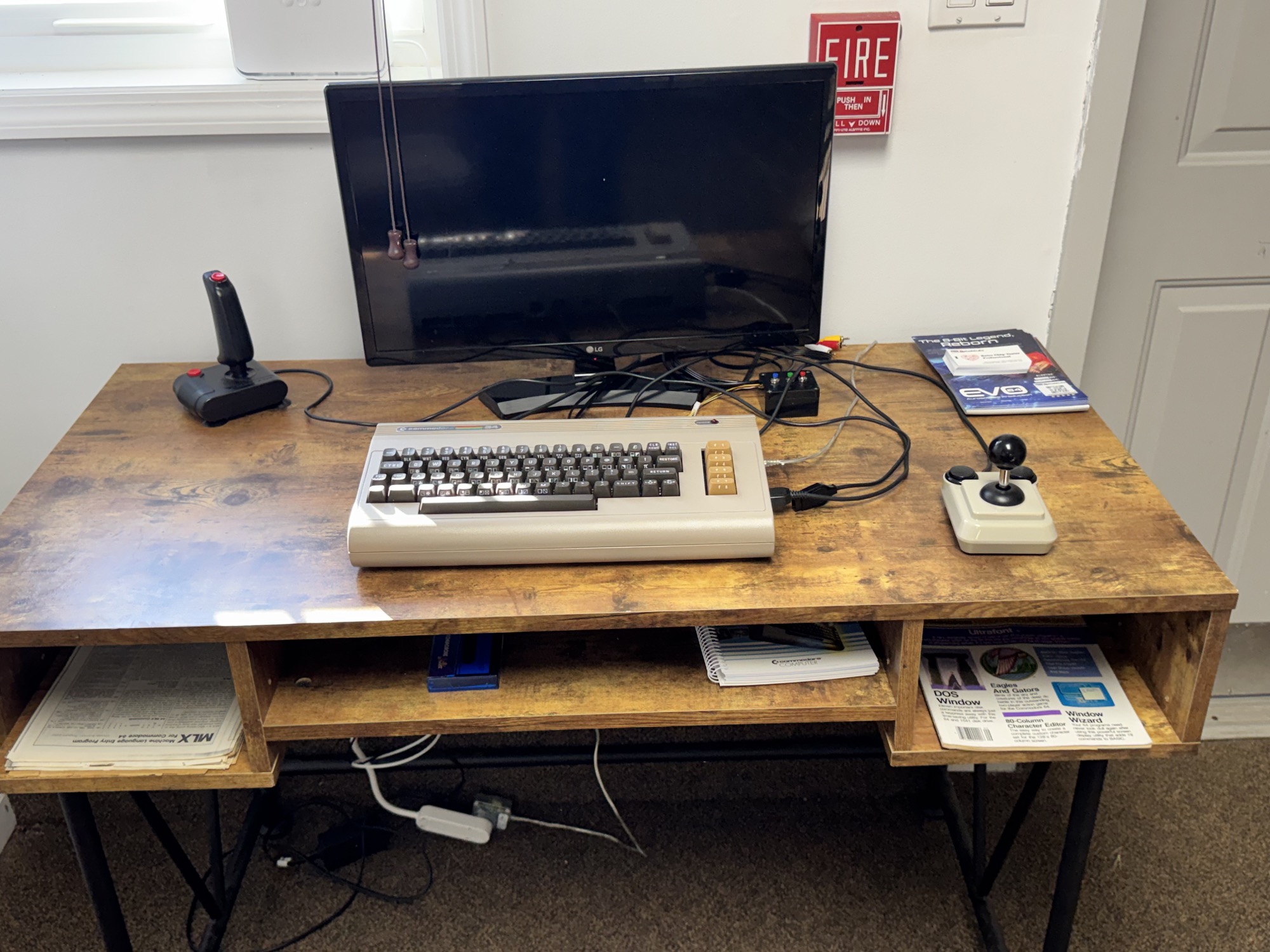
- Commodore 64 Ultimate station
- Modern display and joysticks
- Hands-on sessions by arrangement
Visitors can arrange time at this station to explore the system, play vintage games, and write programs of their own.
Hardware and History
Read: When Commodore Came Back
THE COMMODORE 64 ULTIMATEWhen Commodore Came Back
In 1994, Commodore International went bankrupt.
For a company that had once been one of the biggest names in personal computing, it was an extraordinary ending.
But the Commodore name never really disappeared.
For the next three decades, enthusiasts continued using the machines, repairing them, writing new software, developing new hardware, and keeping an enormous worldwide Commodore community alive.
The name itself passed through a complicated series of owners and licensing arrangements.
Then, in 2025, something rather unexpected happened.
Commodore came back.
A group led by longtime Commodore enthusiast Christian Simpson—better known to many people as Peri Fractic—set out to reunite the surviving Commodore trademarks under a new Commodore International Corporation.
On July 31, 2025, the company announced that it had completed the acquisition of all 47 surviving original Commodore trademarks. Commodore FAQ
And the machine displayed here became an important part of that resurrection.
The Commodore 64 Ultimate.
At first glance, it looks remarkably familiar.
That is intentional.
This particular version, called BASIC Beige, recreates the familiar “breadbin” shape of the Commodore 64 introduced in 1982. It has the same distinctive wedge-shaped case, the same dark keyboard with its unusual graphics symbols, and the same brown function keys along the right side.
But this is not a forty-year-old computer.
And it is not simply a modern PC running a Commodore 64 emulator.
At its heart is an FPGA, or Field-Programmable Gate Array.
Instead of using software to imitate a Commodore 64 from inside another operating system, the FPGA is configured to reproduce the operation of the original computer’s hardware. Commodore describes it as a chip-level recreation of the original C64 motherboard. Commodore 64 Ultimate specifications
That gives the Ultimate an interesting combination of old and new.
It can connect directly to a modern display through HDMI, as this one does.
But it also provides an analog eight-pin video connection for older displays.
It has USB ports, Ethernet and Wi-Fi, yet it retains connections for original Commodore disk drives, datasettes, joysticks and cartridges.
The joysticks beside this machine—one modern and one styled much like a vintage controller—illustrate that bridge between the two eras.
Inside are sockets for two original 6581 or 8580 SID sound chips, allowing vintage Commodore sound hardware to operate alongside the FPGA’s own SID implementation.
And the machine contains 128 megabytes of memory.
To put that into perspective, the original Commodore 64 was named for its 64 kilobytes of RAM.
The Ultimate has roughly two thousand times that amount.
Even its storage mixes nostalgia with modern technology.
Included with this machine was a USB flash drive disguised as an audio cassette and named “The Very Second.”
The name is a playful reference to Commodore’s original C2N Datasette, which stored programs on ordinary cassette tape.
But no tape is hidden inside this one.
It plugs into a USB port and contains games, music, demonstrations and other Commodore 64 software—programs that can be loaded without waiting for a cassette or floppy disk.
The machine also arrived with a substantial spiral-bound user’s guide.
That detail is important.
This was not presented merely as a collector’s circuit board or an unofficial hobby project. It was packaged as a complete, newly manufactured home computer: machine, power supply, HDMI cable, software, quick-start material and printed manual. BASIC Beige package contents
But perhaps the most interesting thing about this machine is not what is inside the case.
It is the name printed across the front.
Commodore.
After decades of bankruptcy, fragmented ownership and licensed products, there was once again a company calling itself Commodore International Corporation, claiming ownership of the surviving original Commodore trademarks and producing new Commodore-branded hardware.
And the people involved were not completely disconnected from the original company.
The revived Commodore brought veterans of the earlier Commodore world into the organization as advisors and contributors. Its listed team has included Albert Charpentier, a principal designer of the VIC-II video chip and co-creator of the SID; Commodore 128 engineer Bil Herd; former Commodore engineer Dave Haynie; and Leonard Tramiel, son of Commodore founder Jack Tramiel. Team Commodore
Perhaps even more remarkably, people actually bought the new machines.
In June 2026, Commodore reported that it had manufactured more than 30,000 new Commodore 64s. That figure is the company’s own reported total, but it suggests that the Ultimate became considerably more than a small novelty for a handful of collectors. Commodore’s June 2026 announcement
And the story is continuing.
The company subsequently announced the Commodore 64C Ultimate, recreating the slimmer C64C design introduced in the 1980s.
For that model, Commodore reacquired the original injection-molding tooling used to manufacture Commodore 64C cases beginning in 1986—and in 2026 demonstrated that tooling producing new cases once again. Commodore’s C64C announcement
So where does the Commodore 64 Ultimate belong in a vintage computer museum?
Technically, it is not vintage at all.
It appeared more than thirty years after the original Commodore company went bankrupt.
But that is precisely why it is here.
The machines throughout this museum tell the story of Commodore’s beginnings: its calculators, MOS Technology, the PET, the VIC-20, the Commodore 64, and the computers that followed.
For many years, that story appeared to have an ending.
1994.
The Commodore 64 Ultimate adds something unusual to that timeline.
Another chapter.
Whether this new Commodore ultimately becomes a major technology company again, or simply serves as the steward of one of computing’s most recognizable names, remains to be seen.
That part of the story is still being written.
But more than forty years after the original Commodore 64 first appeared…
and more than thirty years after Commodore disappeared…
you could once again sit down at a newly manufactured computer, open a newly printed manual, connect a joystick, and see a familiar name across the front:
Commodore 64.
And this time, the story did not end there.