The PET Family
Full-size keyboards, school computers, and the machine that helped inspire LIVCM.
In this section
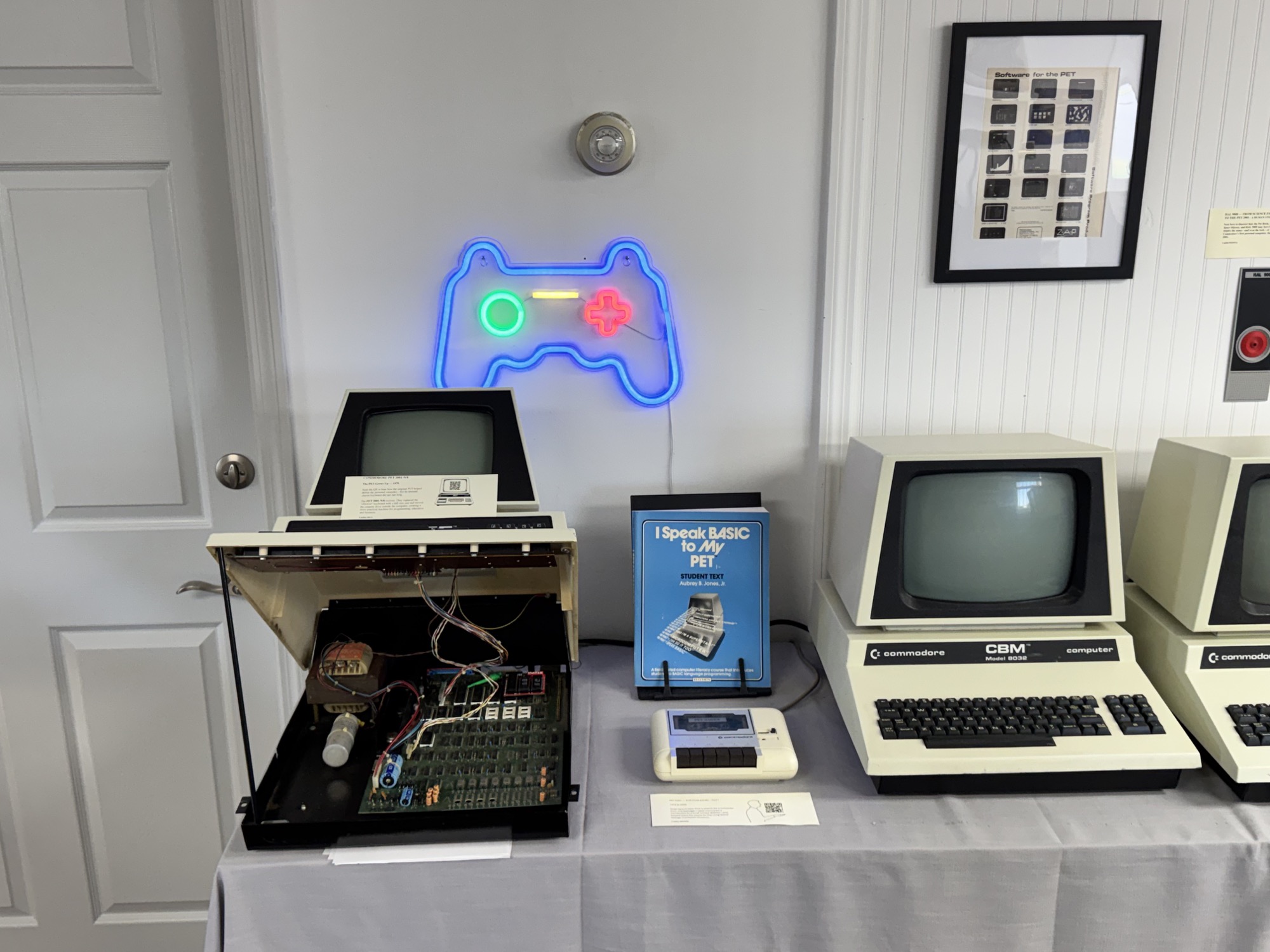
- Open PET showing its electronics
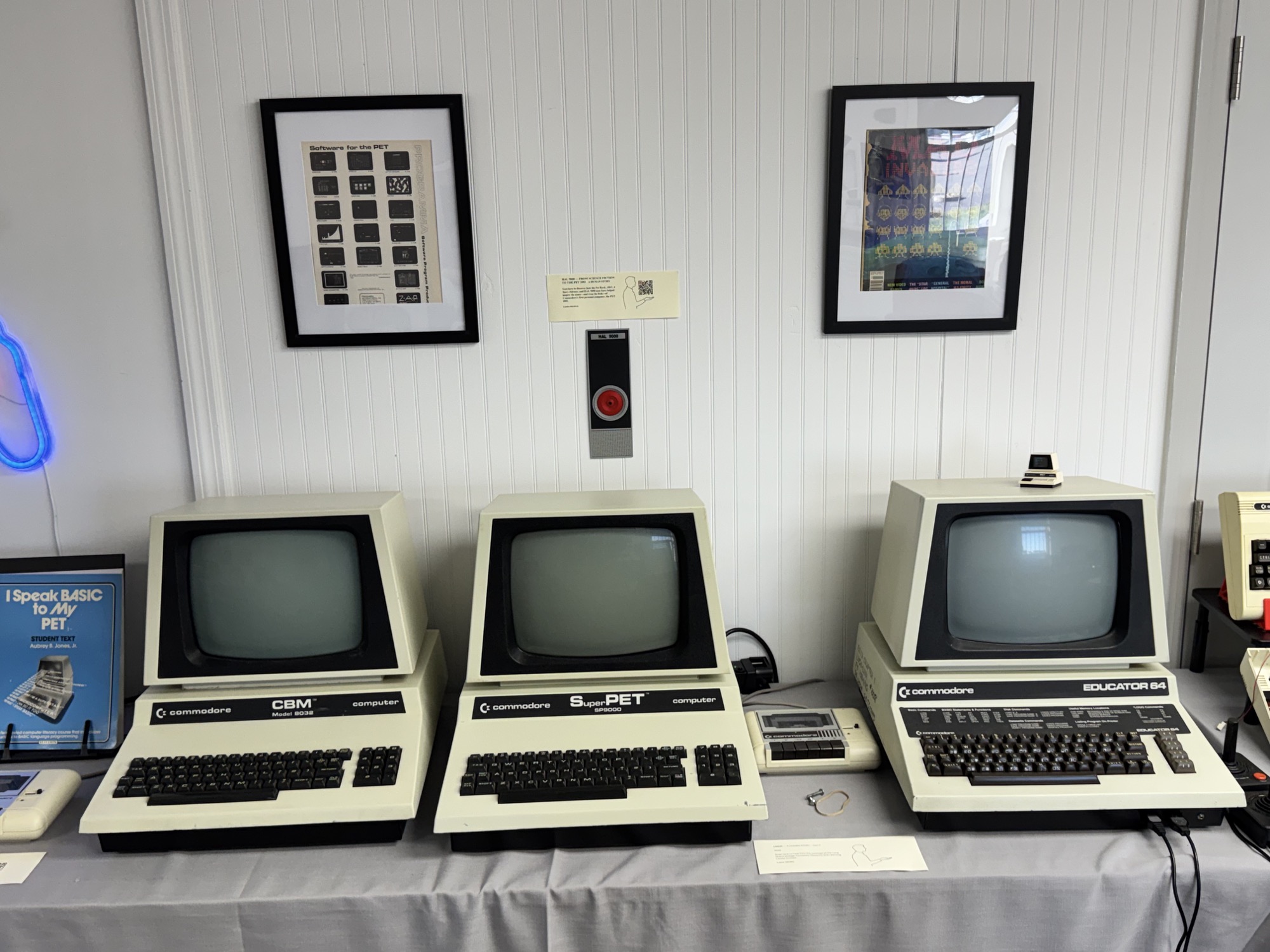
- CBM 8032
- SuperPET SP9000
- Educator 64
- Datasette and I Speak BASIC to My PET
Hardware and History
Read: The PET 2001 — Hardware
Entering data.
Running a business.
Teaching a class.
The keyboard mattered.
And Commodore responded.
Changing the keyboard also changed the physical arrangement of the PET.
The original PET had its cassette recorder—or Datasette—built directly into the computer beside the chiclet keyboard.
The larger keyboard needed that space.
So the cassette drive moved outside the computer and became a separate peripheral.
That made the newer PET slightly less self-contained than the original, but it also made the computer much more practical to use.
The basic philosophy remained the same.
You still had the computer, keyboard and monitor combined into a single substantial metal enclosure.
You could connect a Datasette for storage, turn on the machine, and begin working.
But now the PET was beginning to look less like an experiment in what a personal computer might be...
and more like the computer workstation that would become familiar during the coming decade.
Inside, the basic architecture remained centered around the MOS Technology 6502 microprocessor.
The 6502 ran at approximately one megahertz.
By modern standards, that sounds almost impossibly slow.
But clock speed alone tells very little about what these machines could accomplish.
The processor worked with RAM, ROM and dedicated support circuitry to create a complete computer system.
This particular model designation—2001-N/8—indicates an 8-kilobyte configuration.
Eight kilobytes.
Not eight gigabytes.
Not eight megabytes.
Eight kilobytes of RAM.
That tiny amount of memory had to hold the user's program, variables and working data.
Software therefore had to be written with an economy that is difficult to appreciate today.
Every byte mattered.
And programmers learned to think accordingly.
Much of the PET's personality came from software stored permanently in ROM.
Turn the computer on and you didn't boot an operating system from a disk.
You were presented with Commodore BASIC.
BASIC was not simply another application installed on the machine.
For most users, it was the primary interface to the computer.
You could turn on the PET, sit down at the keyboard, and immediately begin entering commands or writing a program.
A few lines of BASIC could perform a calculation, manipulate text, display information on the screen or begin building something much more ambitious.
And because BASIC was always there when the machine started, programming wasn't hidden from the user.
It was one of the things the computer naturally invited you to do.
That distinction is important.
Today, most people purchase computers to run software written by someone else.
In the late 1970s and early 1980s, owning a personal computer frequently meant learning how to write software yourself.
Storage was another reminder of how different this era was.
Programs could be saved to the Commodore Datasette using ordinary magnetic cassette tape.
Cassette storage was inexpensive, but it was also sequential.
The computer couldn't instantly jump to a file somewhere on the tape.
Finding and loading programs took time.
For more serious use, Commodore offered floppy-disk drives.
And this is where the PET began to reveal another important aspect of Commodore's strategy.
The computer wasn't intended to remain an isolated box.
Commodore developed an expanding family of peripherals around it—disk drives, printers and other equipment connected through the PET's interfaces, including the IEEE-488 bus.
IEEE-488 had roots in laboratory instrumentation, and its use on the PET reflected something about the markets Commodore was beginning to pursue.
This wasn't just a hobby computer.
PET systems were finding their way into schools, laboratories, universities and businesses.
And the industry surrounding these machines was growing just as quickly.
By 1979, personal computing was no longer simply an interesting experiment being pursued by a handful of hobbyists and small companies.
The market was beginning to take shape.
The Commodore PET, Apple II and Radio Shack TRS-80 had established themselves as important platforms.
Companies were producing peripherals for them.
Books and magazines were teaching people how to program them.
Software was becoming something that could be packaged and sold.
Computer stores were appearing.
User groups were forming.
And businesses were beginning to ask a question that would have sounded unusual only a few years earlier:
What could a small computer do for us?
The answer was rapidly becoming: quite a lot.
The PET was particularly successful in education.
Its all-in-one construction made sense in a classroom.
There wasn't a separate computer box, monitor and keyboard connected by a collection of cables.
The heavy metal enclosure was substantial, the monitor was built in, and the computer could be placed on a desk as a single unit.
A student could sit down, turn it on and encounter BASIC almost immediately.
That introduced an entire generation of students to programming.
But the same qualities also made the PET attractive to businesses and technical users.
Add disk storage and a printer, and this relatively small computer could perform work that only a few years earlier might have required access to a much larger computer system.
It could maintain information.
Perform calculations.
Generate reports.
Control equipment.
And run increasingly sophisticated commercial software.
There is also something important happening when we compare this machine with the earlier chiclet PET.
The difference between them is not simply a better keyboard.
We're watching an industry learn from its customers.
The first PET represented Commodore's idea of what a complete personal computer could be.
Machines like the 2001-N represent what happened once people actually started using those computers and telling manufacturers what worked—and what didn't.
And this process was happening throughout the young personal-computer industry.
Memory capacities increased.
Keyboards improved.
Disk drives became more common.
Printers became more capable.
Software became more sophisticated.
And the computer itself was beginning to change from an object primarily purchased by electronics enthusiasts into a practical tool.
Commodore was changing as well.
Only a few years earlier, the company had been known primarily for office equipment and electronic calculators.
Now it was becoming a computer company.
And the PET was establishing something that would become a recurring theme in Commodore's history:
build capable computers around relatively inexpensive technology and make them available to a much larger audience.
That philosophy would soon be pushed much further.
In 1980, Commodore would introduce another 6502-family computer designed to reach an even broader market.
It would have color.
It would connect to an ordinary television.
And instead of being aimed primarily at schools, businesses and technical users, Commodore would aggressively pursue the home.
That computer would be the VIC-20.
And with it, the personal-computer industry was about to become a mass market.
But the transition from the experimental computers of 1977 to that new world can be seen right here.
The original PET established the idea.
The PET 2001-N shows Commodore refining it into a practical computer platform.
The Human Story
PET 2001 — A Human Story — Part I
HAL 9000 — From Science Fiction to the PET 2001
Read: The Seeds of LIVCM Are Planted
THE PET 2001 — A HUMAN STORY
The Seeds of the LIVCM Are Planted
If you've already heard the story of the original chiclet PET, you know that I wanted a Commodore computer—but I decided to wait for a better keyboard.
When Commodore introduced a PET with a full-size keyboard, I finally had the machine I had been waiting for.
I bought one.
I wish I could tell you exactly when. My memory puts it around 1978.
What I do remember is where I bought it.
American Peripherals in Lindenhurst, New York.
I remember buying the PET fairly soon after I learned that the full-keyboard version was available.
The PET cost nearly $800—roughly $4,200 in 2026 dollars.
That was a tremendous amount of money in the late 1970s—especially for a teenager.
Fortunately, I had been working for several years.
Back in Hicksville, I had run a neighborhood lawn-mowing business and also worked in a luncheonette. By the time I was living in Fort Salonga, I was working as a technician for a company that manufactured automobile radar detectors.
So, somewhat unusually for a seventeen-year-old, I had accumulated a fair amount of cash.
Although I can't claim this was the result of some brilliant teenage financial plan.
There just weren't that many ways for a seventeen-year-old to blow a large amount of money in the late 1970s.
You could wander through Sears or Radio Shack for gadgets. You could buy a CB radio or a ten-speed bike. Maybe buy a used car… all of which I did. And I suppose there were some less productive ways a teenager could dispose of his money, but those weren't particularly interesting to me.
What was interesting to me was electronics and computers.
And when the PET I had been waiting for finally appeared—with the full-size keyboard and the 6502 processor I already knew—I was in the unusual position of being a teenager who actually had enough money to buy one.
So I did.
There was no grand plan behind that decision.
I wasn't investing in my future career.
I didn't know where personal computing was going.
I just wanted a computer.
I wanted to learn.
I wanted to program it.
And I wanted to find out what I could make it do.
One of the few artifacts I still have from that original PET is a book called I Speak BASIC to My PET.
This isn't a replacement copy I found years later.
It's the actual book I used to help teach myself BASIC programming.
Learning to program then was a very different experience.
There was no Web to search.
No YouTube.
No online tutorials.
And certainly no AI assistant waiting to explain why your program didn't work.
You had manuals and books.
You read them.
You typed in examples.
You made mistakes.
And you figured things out.
I Speak BASIC to My PET was one of the books that helped me make the transition from understanding a microprocessor at a very low level to actually writing useful programs on a complete personal computer.
And there's a small detail inside this particular book that makes it especially personal to me.
My initials are stamped inside it.
I made that stamp myself in shop class when I was in junior high school.
At the time, it was just another shop-class assignment. I certainly didn't think there was anything significant about it.
I couldn't possibly have imagined that literally fifty years later I would still have the book—or that those little stamped red initials would provide such a tangible connection to the teenager who was using it to learn how to program.
Unfortunately, I don't still have my original PET.
But I do remember what happened to it.
I traded it in toward a SuperPET.
And, interestingly enough, that happened at American Peripherals too—the same store in Lindenhurst where I had bought my PET.
In fact, there's a SuperPET on display on the table behind you.
There's another story there—including how I eventually wound up working for American Peripherals myself and what happened to my SuperPET.
But we'll save that for later.
At the time, trading in my PET didn't feel like giving away a piece of history.
It was simply what you did with technology.
You had one computer.
A more capable computer came along.
You traded up.
We didn't think of these machines as historical artifacts.
They were tools.
And for decades, I didn't think very much about replacing my original PET.
Then, many years later, something unexpected happened.
On purely a whim, I purchased a brand-new Commodore 64 Ultimate from the reincarnated Commodore company.
There's another story there too.
But while I was waiting for the Ultimate to arrive, I started thinking about my old PET computers.
And that, in turn, inspired me to try to recover a small piece of my own past.
Call it nostalgia. Call it a midlife—or perhaps late-life—crisis.
Whatever the reason, I wanted to sit in front of that computer again.
I wanted the same model I remembered.
And let's not kid ourselves.
At that point, the focus was all about me.
Eventually, in early 2026, I found one for sale in Forest Hills, New York.
The gentleman who owned it told me that he had acquired it at a computer swap meet near Kennedy Airport sometime in the early 2000s.
He had owned it for more than twenty years, but before that swap meet, its history was largely unknown.
Ironically, he hadn't used it very much because the keyboard had some serious problems.
That didn't particularly matter to me.
It was the model I had been looking for.
So I bought it, brought it home, and set about getting the keyboard working properly again.
And then my daughter discovered something.
While we were working on the keyboard, she found words that someone had etched into the computer:
“Property of Sayville School District.”
Now, finding a school district's name on an old Commodore PET isn't particularly surprising.
PETs were widely used in education.
But this wasn't just any school district.
I had lived in Fort Salonga when I owned my original PET.
But decades later, I was now living in Sayville.
Without knowing it, I had gone looking for a computer from my own youth and purchased one that had once belonged to my local school district.
And that's when another rather unlikely thought occurred to me.
What if this actually was my original PET?
I had traded my PET in at American Peripherals decades earlier, and I have no idea what happened to it after that.
So technically, I suppose it's possible that American Peripherals eventually sold that same PET to the Sayville School District.
Years later, Sayville could have disposed of it.
Somehow it could have made its way to the computer swap meet near Kennedy Airport.
From there it went to the collector in Forest Hills.
And then, nearly fifty years after I originally traded it in, I could have unknowingly bought my own computer back.
Do I think that's what actually happened?
Probably not.
But I can't completely rule it out.
And wouldn't that be some story?
Since discovering the inscription, I've talked with local people who actually remember Sayville's Commodore computers.
One friend remembers owning one after the district disposed of them—and eventually throwing it away.
Another told me he remembers using one in kindergarten.
That one made me feel particularly old.
What I do know is that at some point this PET left the Sayville School District.
Eventually, it made its way to a computer swap meet near Kennedy Airport.
From there, it went home with a collector in Forest Hills, where it remained for more than twenty years.
Then I came along.
I bought it without knowing any of that history and brought it back to Suffolk County.
Today it sits here in Bohemia, right next door to Sayville.
After all those years and all those miles...
the PET had come home.
Unfortunately, that's about as far as I've been able to trace its history.
I don't know which Sayville school had it.
I don't know which classroom it occupied.
I don't know which teacher used it.
And I don't know how many students sat in front of this keyboard.
But strangely enough, it was those unanswered questions that began to fascinate me.
Who used this computer?
Was this the first computer some student ever touched?
Did someone sit in front of this PET and learn BASIC?
Did it spark an interest in electronics, programming, or engineering?
And did that experience influence what that student eventually did with his or her life?
I may never know.
But I began asking the same questions about the other old computers I was finding.
Where had they been?
Who had used them?
What stories had disappeared while the machines themselves somehow survived?
I had originally bought this PET because I was interested in my past.
Suddenly, I became interested in its past—and in whether preserving machines like this might somehow give me an opportunity to pay something forward to the next generation.
And there was something particularly appropriate about this machine being the one that caused me to think that way.
This PET had already spent part of its life doing exactly that.
It had been in a school.
Long before I owned it, young people had sat in front of it.
They had touched this keyboard.
They had seen this screen.
Some of them may have written their first computer programs on it.
For all I know, one of them may have gone on to become a programmer or an engineer—or simply a neighbor of mine.
Suddenly, the words scratched into this computer didn't seem like damage.
They were provenance.
They told me something about where the machine had been and what it had done.
And that began to change the way I looked at old computers.
But there's a bit of irony here.
I had already started cosmetically cleaning this PET.
In fact, I had taken a Magic Eraser to the case. And it was while we were cleaning and working on the machine that we discovered the Sayville School District marking.
That experience changed my thinking.
I realized that in trying to make an old computer look new again, I might actually erase some of the very history I was becoming interested in preserving.
This became the first—and the last—Commodore in the collection that I would deliberately try to cosmetically restore.
I still wanted the computers repaired, wherever practical.
I wanted them electronically operational so that people could experience what using them was actually like.
But the scratches, fading, inventory numbers, names and other signs of their previous lives?
Those were becoming part of the exhibit.
These machines had lives before they came to me.
They had been in homes.
Schools.
Offices.
Laboratories.
People had learned on them.
Worked on them.
Played on them.
And in some cases, perhaps had their lives changed by them.
Most of those individual stories are probably gone forever.
But the machines remain.
And occasionally, if we're lucky, someone scratched the name of a school district into one of them and left us a clue.
At that point, I didn't have a museum.
I didn't have a building full of exhibits.
And I certainly didn't have a master plan for what all of this would eventually become.
But the idea was beginning to form.
I had started out looking for computers from my own past.
This PET made me realize that preserving them could be about something much larger than that.
It could be about preserving the machines and their stories.
And perhaps it could also become a way to give another generation an opportunity to discover some of the same things these machines had once allowed my generation to discover.
I didn't yet know exactly what that would look like.
That would come later.
But looking back now, I can see the moment when the idea began to take root.
My original PET helped begin my life with computers.
This PET planted the seeds for what would eventually become the Long Island Vintage Computer Museum.
But planting the seed was one thing.
Deciding what kind of museum I wanted it to become was another story entirely.
Read: Where the Stories Finally Meet
The PET 2001 — Where the Stories Finally Meet
And this is where those two stories finally come together.
By the late 1970s, I had already begun learning about microprocessors with my MOS Technology KIM-1.
But the KIM-1 wasn't what most people today would recognize as a personal computer. There was no conventional keyboard or monitor. I entered programs directly in hexadecimal using a small keypad and watched the results on a six-digit LED display.
I was learning how a computer worked from the inside out.
But now I wanted a complete computer.
I began studying the machines that were becoming available.
The Radio Shack TRS-80 was certainly on my radar. So were the inexpensive computers that would become associated with Sinclair.
And then there was Commodore.
Commodore interested me for one very important reason:
the PET used the MOS Technology 6502.
I already knew that processor from my KIM-1.
Chuck Peddle had helped develop the 6502 at MOS Technology and had also been instrumental in creating the KIM-1. When Commodore acquired MOS, it gained not only the technology, but also much of the engineering talent behind it.
So there was already something familiar about the PET to me.
What I didn't appreciate at the time was that the Apple II was also based on the 6502.
Today, the Apple II, TRS-80, and Commodore PET are frequently referred to as the 1977 Trinity—three machines that helped move personal computing out of the hobbyist world and toward complete computers that ordinary people could purchase and use.
But Apple simply wasn't on my radar.
I never seriously considered one.
Had it been, perhaps my computer history—and maybe even this museum—would look very different today.
But I digress.
There was one thing about the original PET that concerned me.
That little calculator-style chiclet keyboard.
I wanted something that felt more like a real keyboard.
Although that's an interesting statement in itself, because in the late 1970s there really wasn't yet a universally established idea of what a personal-computer keyboard was supposed to look like.
Manufacturers were still figuring this stuff out.
Commodore eventually replaced the chiclet keyboard with a full-size keyboard. Making room for it meant moving the built-in cassette recorder outside the computer.
And once Commodore did that...
I was sold.
I wish I could tell you exactly when I purchased my PET 2001/8.
I can't.
It was either 1978 or 1979.
What I do remember is how I paid for it.
Once again, it was the profits from my neighborhood lawn-mowing business.
An 8K PET was selling for around $795 during this period.
That was an extraordinary amount of money, particularly for someone my age. In today's dollars, we're talking about several thousand dollars.
Looking back now, I'm actually amazed that I had the nerve—or perhaps the lack of good sense—to spend that much of the money I'd earned mowing lawns on what, at the time, could reasonably have looked like an extremely expensive toy.
And here's the important part:
I had absolutely no idea I was preparing myself for the future.
There was no grand career plan behind this purchase.
I didn't foresee the personal-computer revolution.
I certainly didn't know that computers would eventually become the foundation of my professional life.
I just thought the technology was fascinating.
I wanted to understand it.
I wanted to program it.
And I wanted to see what I could make it do.
So I spent the money.
I also bought the cassette drive.
This was our mass storage.
No hard drive.
No USB stick.
No cloud.
Programs were stored as data on ordinary magnetic cassette tape.
Loading something could take minutes, and you learned very quickly to appreciate that little tape counter.
Then I needed a printer.
My father, a retired New York City motorcycle police officer, drove me into Manhattan to buy one from a private seller.
I still remember pulling up in front of the apartment building.
My father double-parked, looked at me, and said:
“Okay, go up and get your computer.”
Now, you have to understand the difference in perspective here.
My father had spent his career as a New York City police officer. To him, this was just another apartment building in Manhattan.
No big deal.
To me?
Danger, Will Robinson!
I remember sitting there thinking:
Wait a minute. You want me to walk into some stranger's apartment in New York City, by myself, with a wad of money in my pocket—and decide whether I should buy this printer? What if this guy robs me?
But that's not what I said.
What I said was:
“Okay.”
So I went upstairs, met the seller, looked over the printer, made the deal, and came back down with it.
Looking back, I suppose my father had considerably more confidence in me than I had in myself at that particular moment.
And with the PET, cassette drive, and now a printer, I suddenly had something remarkable:
I had everything I needed to start a business.
So I did.
Well...
technically my second business, if we count the lawn-mowing empire.
I started selling customized horoscopes through advertisements in the back of magazines.
People would send me a check, a self-addressed stamped envelope, their birth date, and the date for which they wanted their horoscope.
I wrote an algorithm that combined their birth date, the target date, and a few other somewhat spurious factoids.
From that, the computer generated a random number, which I used to select a horoscope from a large file of prepared horoscopes.
The PET generated the result.
I printed it.
Put it into their self-addressed stamped envelope.
And mailed it back.
Was it truly their horoscope?
Beats the heck out of me.
But it worked.
And looking back, something rather interesting was happening.
As a teenager in the late 1970s, I was already using a personal computer to automate a small mail-order business.
At the time, though, I certainly wasn't thinking about it in those terms.
I was just figuring out interesting things I could make my new computer do.
At some point along the way, I purchased this book, I Speak BASIC to My PET, to expand my knowledge of BASIC programming.
Remember how we learned things then.
There was no World Wide Web.
No YouTube.
No online tutorials.
And certainly no AI assistant waiting for you to ask a programming question.
You bought books.
You read manuals.
You looked at other people's programs.
And then you experimented.
And I found other things to do with the PET.
I'm a guitarist, and another friend of mine was also a musician.
So naturally, we decided that what the world desperately needed was Beach Boys music translated to 8-bit Commodore computers.
We called our little endeavor:
PET Sounds.
Yes.
We knew exactly what we were doing with that name.
We began translating Beach Boys songs so they could be reproduced using Commodore computers.
And I had what I considered a brilliant marketing strategy.
I hoped we'd become successful enough that the Beach Boys would sue us.
Then I'd get to meet the Beach Boys.
Unfortunately, we never achieved that level of success.
No lawsuit.
No meeting.
There's also something wonderfully late-1970s about the identity Commodore created for this machine.
The PET name has a documented connection to the Pet Rock craze.
Chuck Peddle later recalled that the idea of a "pet computer" grew out of seeing the remarkable popularity of the Pet Rock. The expansion of PET into Personal Electronic Transactor came afterward as a way of fitting words to the name.
So here was this strange new technology being presented not as some intimidating electronic brain...
but as your PET.
Something personal.
Something approachable.
Something that could live in your home.
And then there is that wonderfully evocative number:
2001.
It's almost impossible for me to see that number on a computer from this era without thinking about Stanley Kubrick's 2001: A Space Odyssey and its fictional computer...
HAL 9000.
I don't want to tell you that Commodore chose the number 2001 because of the movie, because I haven't found documentation strong enough to establish that as fact.
But the cultural connection is certainly hard to miss.
HAL represented one vision of what people imagined the computer of the future might become.
It could see.
It could speak.
It could reason.
It could operate a spacecraft.
My PET 2001 was considerably less ambitious.
It couldn't hold a conversation with me.
It couldn't run a spacecraft.
And thankfully, it never refused to open the pod bay doors.
But it was mine.
And that's what makes this computer so important to me today.
The KIM-1 taught me about the inside of a computer.
The PET gave me a computer I could actually use.
I could write software.
Store programs.
Print results.
Learn BASIC.
Experiment.
Start ridiculous little businesses.
And even attempt to make Beach Boys music.
But here's something I find remarkable looking back on all of this now:
It took me more than forty years to fully appreciate just how important these two little computers had been to my life.
At the time, the KIM-1 was something fascinating to experiment with.
The PET was an incredibly expensive piece of technology that I desperately wanted to explore.
I wasn't consciously building a foundation for an engineering career.
I wasn't preparing myself for jobs that didn't even exist yet.
I certainly wasn't planning a computer museum more than forty years in the future.
I was simply following my curiosity.
And yet, in retrospect, the KIM-1 and this PET probably did more to prepare me for what came next than I could possibly have understood at the time.
The KIM-1 taught me to think at the level of the processor—to understand hexadecimal, machine instructions, memory, and what was actually happening inside the computer.
The PET let me take that knowledge and begin doing things with a computer.
Writing programs.
Solving problems.
Creating applications.
And discovering that if I could imagine something, there was a pretty good chance I could figure out how to make the computer do it.
And this is also where those two separate historical paths I've talked about in the previous exhibits finally collided.
Commodore acquired MOS Technology.
MOS had created the 6502 and the KIM-1.
The KIM-1 introduced me to microprocessors.
Chuck Peddle and the MOS engineering team brought that technology into Commodore and helped create the PET.
And now I had spent the profits from my lawn-mowing business to buy one.
I couldn't possibly have known where any of this was going.
It took me more than four decades to look backward and finally see the path clearly myself.
And maybe that's one of the most important lessons these machines have taught me.
You don't always know where your curiosity is going to take you.
Sometimes you're not preparing for the future.
You're not building a résumé.
You're not following a career plan.
You're simply fascinated by something...
so you learn everything you can about it.
For me, it was the KIM-1 and the Commodore PET.
And only many years later did I fully understand just how profoundly those two machines had influenced everything that followed.
This wasn't simply my first Commodore computer.
This was where my life with Commodore really began.
Although, as you'll discover later in this story, that relationship wasn't continuous.
Within only a few years, professional computers would take me in an entirely different direction—and Commodore would largely disappear from my life for decades.