The MOS Processor Story
A closer look at the chips behind the machines—and a mystery still being researched.
In this section
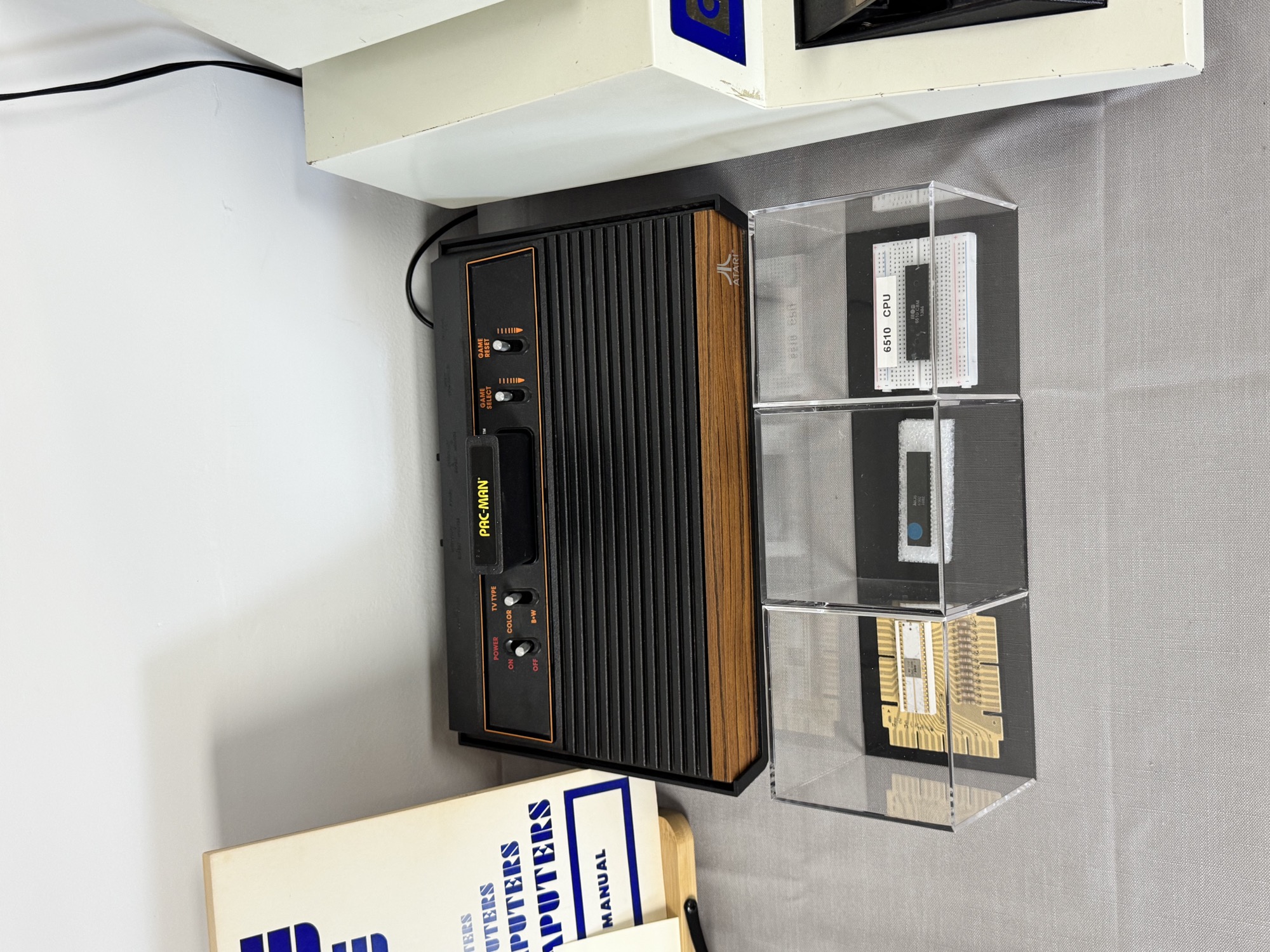
- MOS MCC 5501 and its unusual carrier
- 6502 and 6510 processor displays
- Atari console connecting the tour to the 6507
Hardware and History
Read: The Mysterious MOS 5501
The Mysterious MOS 5501
This small device is one of the more mysterious artifacts in the museum.
The chip is marked MOS MCC 5501 and is mounted in an unusual white ceramic package with gold-plated leads. Even more intriguing is the circuit board surrounding it, with gold contacts on three sides and a row of discrete resistors. The board itself is marked 071468-12T.
MOS Technology is, of course, the company that gave us the 6502 microprocessor and the KIM-1—and which would eventually become part of Commodore.
But unlike famous MOS chips such as the 6502, very little documentation appears to have survived for this particular device. Even its date markings haven't yet been conclusively decoded, so I don't want to assign it a manufacture date that we can't substantiate.
And that's actually part of why I've chosen to display it.
Computer museums naturally tend to concentrate on technologies whose histories we already understand. But artifacts like this remind us that some of the history of early semiconductor technology has simply been lost or remains to be rediscovered.
The unusual carrier and circuit board may ultimately prove to be just as historically interesting as the chip itself.
Below it I've placed something much more recognizable: a MOS 6510, the processor used in the Commodore 64.
Together, they provide an interesting contrast.
One is an obscure MOS device whose original purpose we're still trying to determine.
The other is a descendant of MOS Technology's enormously influential 6502 family that went on to help power the best-selling Commodore 64.
So this exhibit is also intentionally a bit of an unfinished story.
As additional information about the MCC 5501 is discovered, we'll continue researching it—and hopefully, someday, determine exactly what this unusual piece of early MOS Technology was designed to do.