Before Calculators and CAD
Slide rules, aviation calculations, and the tools of hand-drawn digital design.
In this section
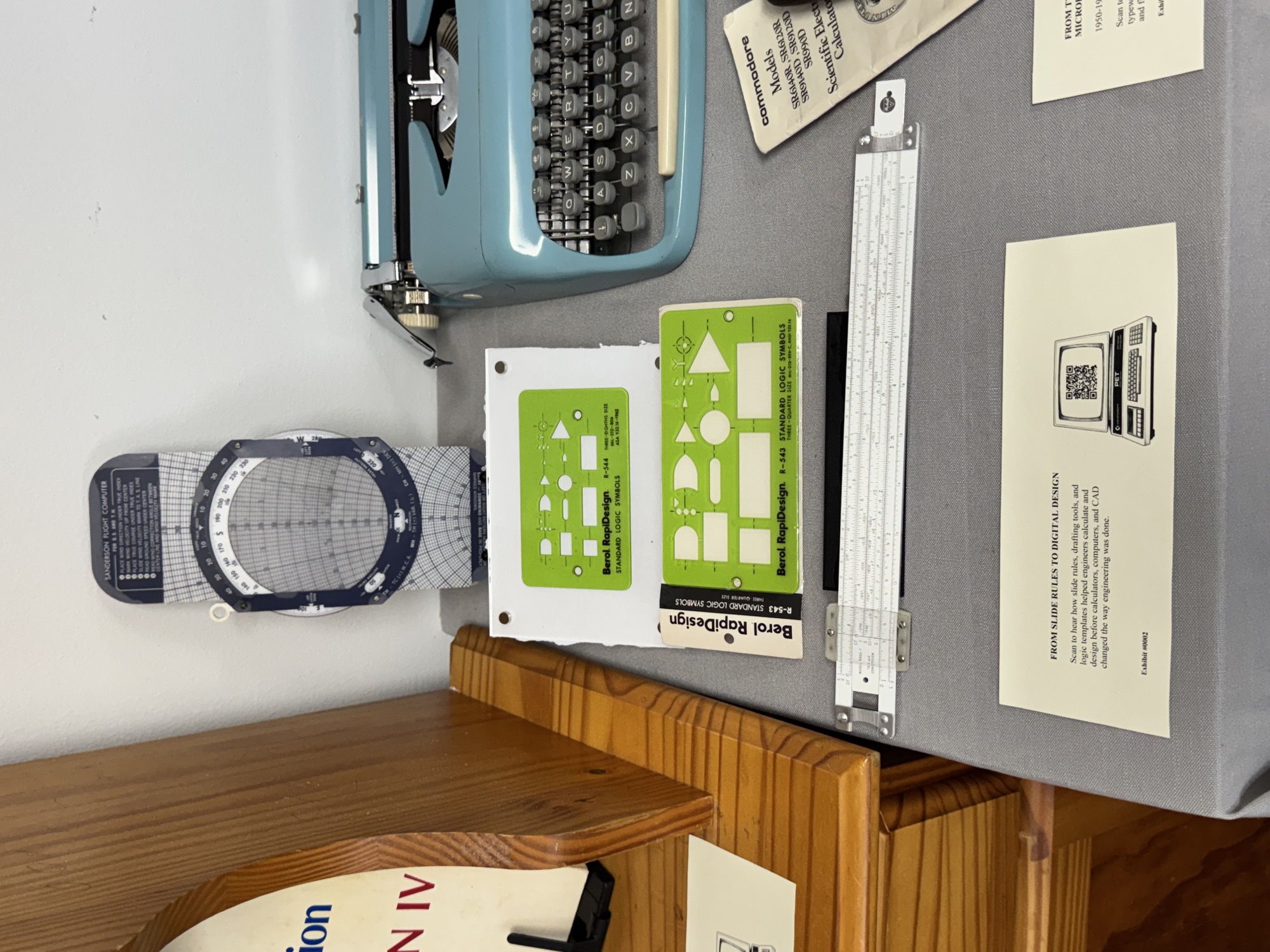
- Straight slide rule
- Sanderson flight computer
- Berol RapiDesign logic templates
Hardware and History
Read: Before Calculators and CAD
Today, an engineering student can sit down at a computer and perform complex calculations almost instantly. Circuit diagrams can be drawn in software, sophisticated error checking can identify mistakes early, components moved around with a mouse, and an entire design revised without ever touching a pencil.
Before the advent of computers, much of that work was still done by hand.
The objects in this display are examples of the tools we used—and unlike many of the historical artifacts in this museum, these are tools that were part of my own education.
Before inexpensive electronic calculators became commonplace, one of the most important tools available to engineers and scientists was the slide rule.
A slide rule doesn't contain any electronics. It works through logarithmic scales. By physically sliding those scales relative to one another, you can perform multiplication and division, calculate powers and roots, and solve many of the mathematical problems encountered in science and engineering.
There is no digital display and no equals button.
And perhaps most surprisingly to someone seeing one for the first time today, the slide rule doesn't automatically tell you where the decimal point belongs.
You have to understand the calculation well enough to determine the magnitude of the answer yourself.
That meant the tool didn't replace mathematical understanding. It depended upon it.
By the time I began engineering school, traditional slide rules were already disappearing as electronic calculators became affordable.
But I personally used this circular slide rule, or mechanical flight computer, in 1977 while working toward my private pilot certification.
A pilot could use a device like this to perform calculations involving speed, time, distance, fuel consumption and other flight-planning problems.
There was no software involved. You physically rotated the scales, aligned the appropriate values, and read the result.
So even as electronic calculators were beginning to replace the traditional engineer's slide rule, the same basic principles were still very much alive in aviation.
Calculation was only part of the job.
Engineers also needed to communicate their designs.
Today, if I want to draw a logic diagram, I can open a computer application, select a logic gate and place a perfectly formed symbol on the screen.
In the 1970s and well into the 1980s, we often did something much more literal.
We traced it.
These are logic-symbol templates, or stencils.
The openings represent the standard symbols used for AND gates, OR gates, inverters and other elements of digital logic.
You placed the template over paper, inserted a pencil or technical pen, and traced the symbol.
Then you moved the stencil and drew the next one.
I personally continued using physical logic templates like these through the 1980s.
If I needed to produce a neat logic diagram or circuit drawing, there was no convenient drag-and-drop CAD package sitting on my desk.
The engineer created the drawing.
And if the design changed significantly, you might be doing quite a bit of erasing—or drawing portions of it again.
These tools illustrate something important about the computer revolution that can easily be overlooked.
Computers didn't merely become another tool used by engineers.
They gradually absorbed many of the tools engineers had already been using.
The slide rule gave way to the electronic calculator and then to mathematical software.
The drafting table, pencil and plastic templates increasingly gave way to computer-aided design.
During the late 1980s and into the early 1990s, computer technology increasingly made digital CAD practical and accessible. Circuit and logic diagrams that once had to be painstakingly drawn by hand could now be created, edited, copied and stored electronically.
And engineering changed with it.
That's one reason I've preserved these particular objects.
For me, they're not simply artifacts representing how somebody else once worked.
I actually used tools like these.
I used the circular flight computer while learning to fly in 1977.
I used physical logic templates through the 1980s.
And during my own career, I watched the computer evolve from something engineers were learning to design and program into something that fundamentally changed how engineers themselves designed things.
So when you look at the computers elsewhere in this museum, remember that their impact wasn't limited to putting a computer in people's homes.
They also transformed the process by which the next generation of technology was created.
And these simple pieces of plastic, metal, paper and carefully engraved scales help preserve what engineering looked like just before that transformation took place.