Read: The Books Behind the Machines
The Books Behind the Machines
A museum like this is naturally filled with computers, circuit boards, processors, and other pieces of hardware.
But I've always believed that the history of computing isn't contained only in the machines.
Sometimes it's contained in the books that explained them, documented them, and inspired the people who went on to work with them.
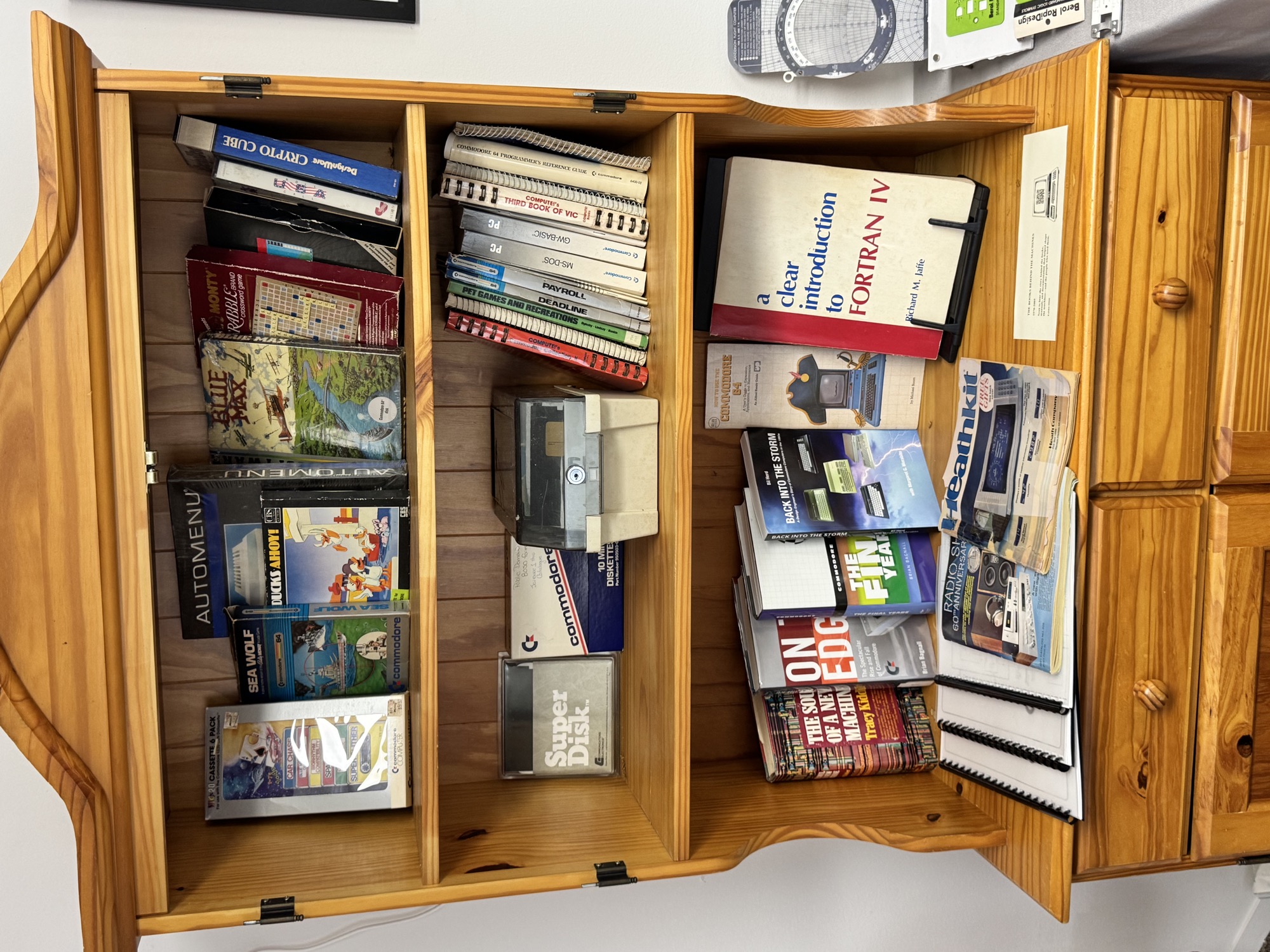
The books and manuals displayed here represent both the history of the computer industry and, in several cases, my own history.
Perhaps the most personally significant book here is this first-edition copy of Tracy Kidder's The Soul of a New Machine.
Published in 1981, the book tells the story of a team of engineers at Data General developing a new 32-bit minicomputer under extraordinary technical and competitive pressure.
I purchased this particular copy in 1981 for less than fourteen dollars.
At the time, I was planning a career primarily in electrical engineering.
And then I read this book.
Kidder's story showed me computer engineering as something that wasn't simply programming and wasn't simply electronics. It was where those two worlds came together—hardware architecture, logic, software, and engineering problem-solving all becoming parts of the same machine.
That idea had a profound effect on me.
It helped move me away from wanting to be strictly an electrical engineer and toward becoming a computer engineer.
More than forty years later, the same copy that helped influence that decision is now sitting here in this museum.
This next book takes me back a little later in my upbringing and plays a role in the Commodore world.
It's Richard M. Jaffe's A Clear Introduction to FORTRAN IV.
During the summer between high school and college, I was preparing for a potential summer internship at NASA's Jet Propulsion Laboratory in California.
I was told that I needed to know FORTRAN.
So I did what we did in those days when we suddenly needed to know something:
I went to a local bookstore and got whatever book I could find. No Amazon back then. Barns & Noble and Borders existed, but I most likely bought it at Walden Books – or just a local mom & pop store.
There was certainly no YouTube or AI either. Back then, if you needed to learn something quickly, you found the appropriate book or manual... and you sat down and read it.
The remaining books bring us into the history that occupies so much of this museum: Commodore.
Brian Bagnall's On the Edge and The Final Years document different periods in the extraordinary—and sometimes turbulent—history of the company.
Commodore's story encompasses far more than the Commodore 64.
It includes calculators, semiconductor manufacturing, the PET, VIC-20, Commodore 64, Amiga, and the engineers, executives, products, successes, failures, and corporate decisions that helped shape the personal-computer industry.
Back Into the Storm, by Bil Herd with Margaret Morabito, gives us another valuable perspective.
Bil Herd was one of the engineers inside Commodore.
That's important because computers don't simply appear because technology has advanced enough to make them possible.
People build them.
Engineers solve problems.
Deadlines arrive. They are either met, pushed back, or projects are canceled.
Designs fail.
Costs matter.
Companies change direction.
And occasionally, remarkable machines emerge from that process.
Books like this connect the finished computers we're preserving here with the people who actually created them.
Then there are documents like these Commodore service and troubleshooting manuals.
These represent another side of preservation that's particularly important to me.
Historical books can tell us why a computer was created.
Service documentation can tell us how it actually works.
Schematics, diagnostic procedures, component information, and troubleshooting instructions allow machines that are now more than forty years old to be understood and repaired rather than simply placed behind glass.
And that's central to what I'm trying to accomplish here.
I don't want this museum merely to preserve old computers as objects.
Whenever practical, I want to preserve the knowledge required to understand them, operate them, diagnose them, repair them, and keep them running.
That's why these books belong beside the computers.
One helped change the direction of my career.
I vividly remember speed-reading the “”a clear introduction to FORTRAN IV” book on a United Airlines flight from New York to California, trying to absorb as much FORTRAN as I could before I arrived…
Other books, which we'll encounter later, became working references while I was programming NOVA 4 computers professionally or teaching BASIC programming to adults.
Still others preserve the history of Commodore and the memories of the people who actually built these machines.
And the service manuals preserve something equally important:
the knowledge necessary to keep those machines alive.
The upper shelves contain still more Commodore software and documentation—another part of the information necessary to understand what these machines were actually capable of doing.
So, for me, this collection of books isn't really separate from the collection of computers.
The books explain the machines.
The manuals taught people like me how to work with them.
And in at least one case, a fourteen-dollar book helped determine the direction of my life.
That's why preserving computer history means preserving more than just hardware.
It means preserving the ideas, documentation, and experiences behind the hardware—and the people on both sides of the keyboard.